Retired Instruments
Instruments formerly in service at the UWPR, kept here as a historical record.
LTQ
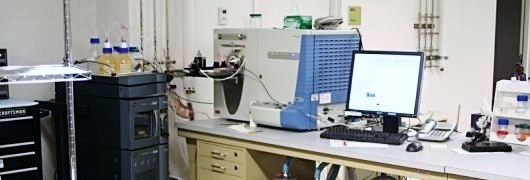
Linear ion trap mass spectrometer with CID and PQD dissociation.
- Installed 9/13/2006, retired 6/1/2012
LTQ-XL
Linear ion trap mass spectrometer with CID and PQD dissociation.
- Installed 10/8/2018, retired 10/8/2018
LTQ XL with ETD (LTQ-ETD)
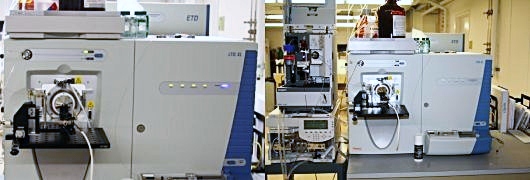
Linear ion trap mass spectrometer with CID, PQD, and electron transfer dissociation (ETD), which preserves labile modifications such as phosphorylation.
- Installed 8/28/2007, retired 1/24/2013
LTQ-FT Ultra
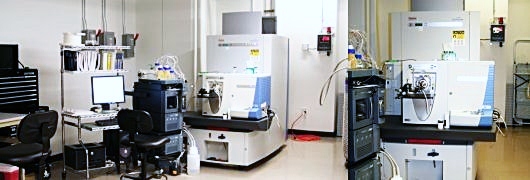
Hybrid instrument combining a linear ion trap with a 7 T FT-ICR mass analyzer (resolution 100,000 at m/z 400 in broadband mode). Supported CID, PQD, ECD, and IRMPD.
- Installed 2/5/2007, upgraded to Ultra cell 10/5/2007
LTQ-Orbitrap XL 1 and 2
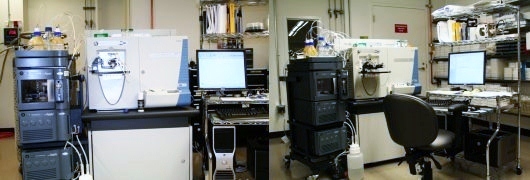
Hybrid linear ion trap / Orbitrap mass spectrometer with an HCD collision cell; resolution up to 100,000 at m/z 400.
- LTQ-OT 1: installed 7/17/2007, retired 9/1/2020
- LTQ-OT 2: installed 8/16/2007, retired 10/1/2015
TSQ Quantum Access
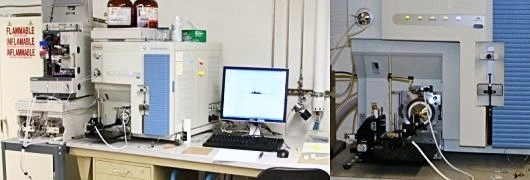
Triple quadrupole mass spectrometer (m/z 30–3,000) supporting timed SRM, H-SRM, iSRM, and QED-MS/MS.
- Installed 6/20/2007, retired 9/30/2018
Base collision energy equations (see the SRM page):
- TSQ Access (1.0 mTorr) 2+ peptide: CE = 0.049 × m/z − 5.750
- TSQ Access (1.0 mTorr) 3+ peptide: CE = 0.039 × m/z + 3.314
Orbitrap Elite
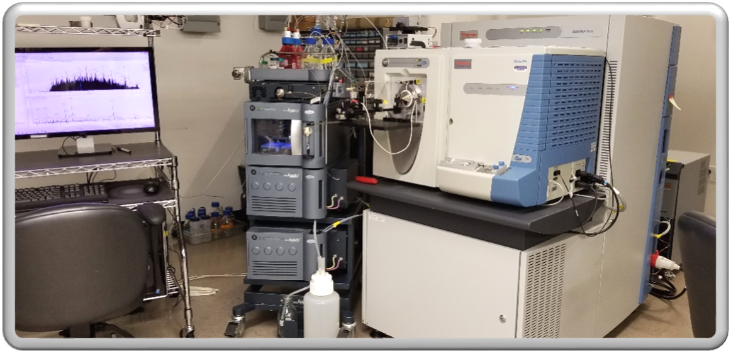
Hybrid dual linear ion trap (Velos Pro) / high-field Orbitrap mass spectrometer; resolution 15,000–240,000 at m/z 400; CID, PQD, and HCD dissociation.
- Installed 2011 as Velos Orbitrap, upgraded to Elite 2012
Q Exactive Plus
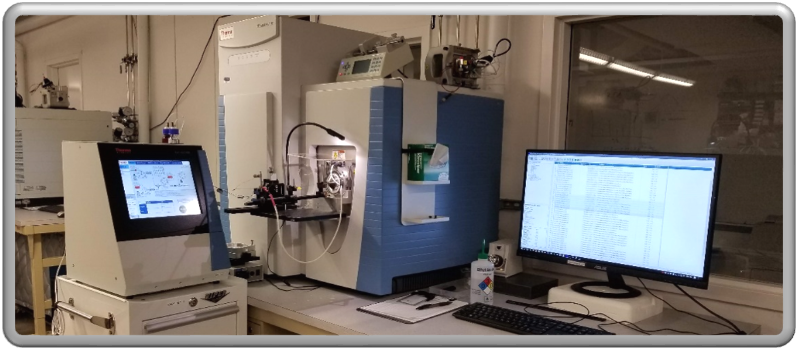
Benchtop quadrupole-Orbitrap mass spectrometer with HCD dissociation and spectral multiplexing; resolution up to 280,000 at m/z 200.
- QE: installed 6/6/2012, upgraded 11/14/2013
- QE Plus: installed 11/19/2013
TSQ Vantage
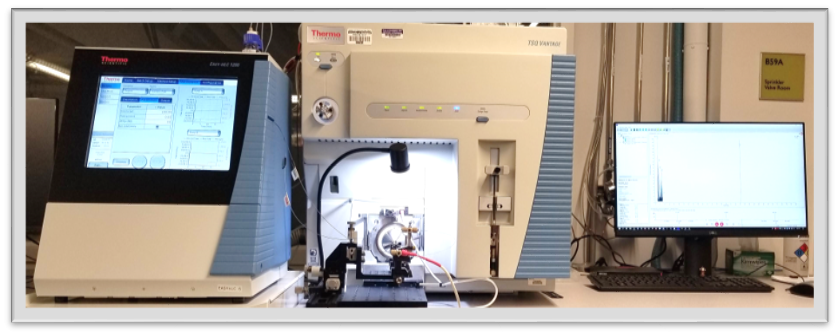
Triple quadrupole mass spectrometer (m/z 10–1,500) with S-lens ion optics and hyperbolic quadrupole mass filters; timed SRM, H-SRM, iSRM, and QED-MS/MS.
- Installed 10/8/2009
Base collision energy equations (see the SRM page):
- TSQ Vantage (1.0 mTorr) 2+ peptide: CE = 0.041 × m/z − 3.442
- TSQ Vantage (1.0 mTorr) 3+ peptide: CE = 0.040 × m/z + 0.773
- TSQ Vantage (1.5 mTorr) 2+ peptide: CE = 0.030 × m/z + 2.905
- TSQ Vantage (1.5 mTorr) 3+ peptide: CE = 0.038 × m/z + 2.281
nanoAcquity
Waters nano-scale UPLC systems for peptide separations; eight units installed 2007–2010.